


Software-delivery throughput is bounded less by engineering capacity than by the availability of the systems engineers depend upon. Service virtualization relaxes that constraint — converting blocked time into delivery time, with measurable returns across efficiency, quality, and infrastructure cost.
Velocity is gated by dependency availability, not effort.
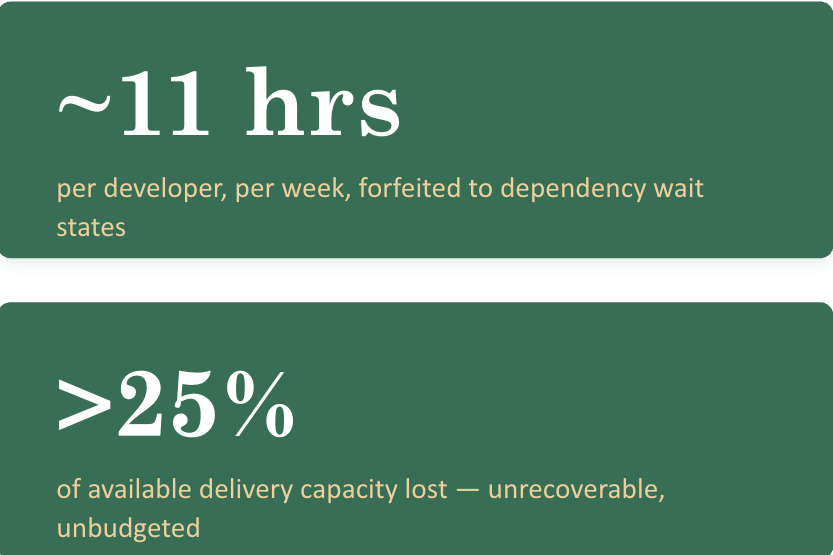
When teams are instrumented to record idle time attributable to external dependencies - unavailable environments, unresponsive third-party APIs, contested downstream systems - the loss is consistently large and consistently invisible. In one measured engagement, a nine-developer team forfeited a mean of eleven hours per person, per week, to dependency wait states.
That is over a quarter of available capacity — unrecoverable and unbudgeted. The cause is not the quality of the engineering; it is a queueing problem, and it is tractable.
Three mechanisms, one intervention.
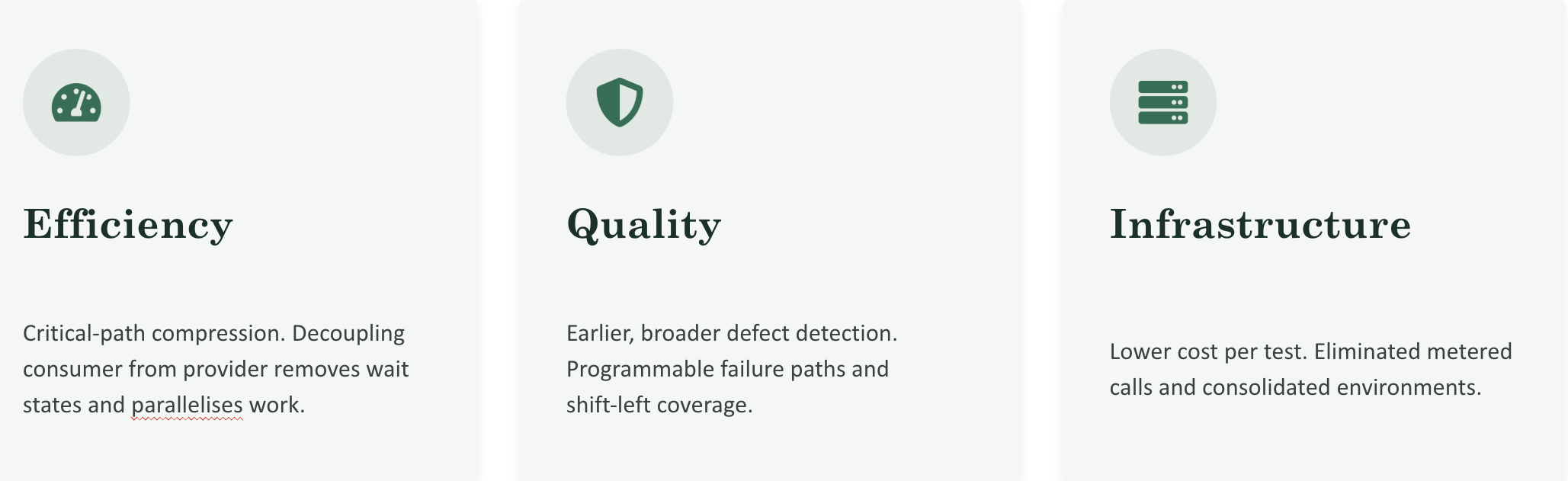
Service virtualization substitutes a controllable, high-fidelity model for a dependency that is unavailable, contested, or costly. The return decomposes cleanly along three vectors:
Decoupling collapses the critical path.
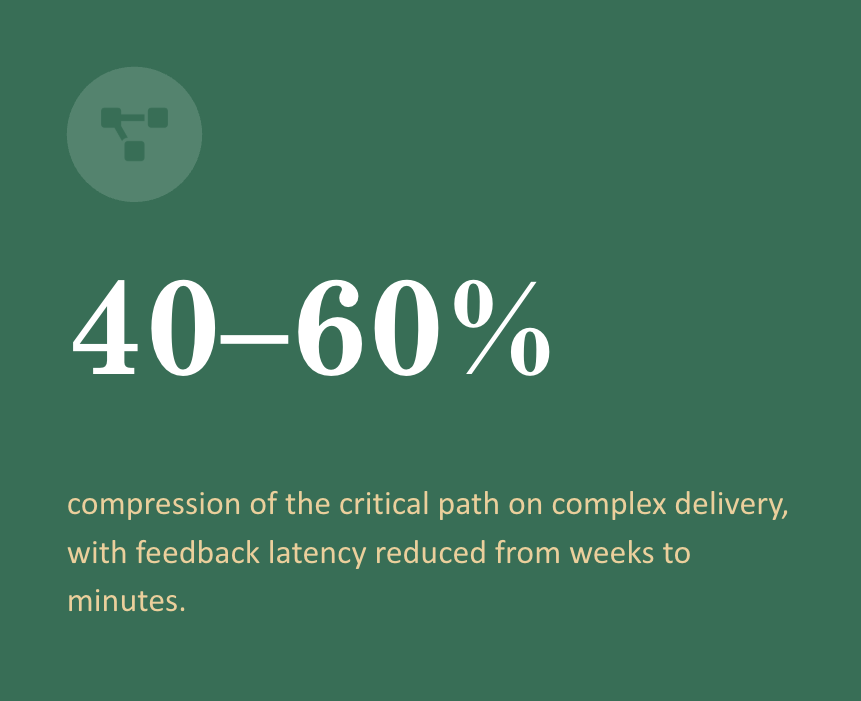
Developed against a shared contract rather than a live integration, consumer and provider work is no longer serialised: the dependency edge is cut, and teams that previously blocked now proceed concurrently. Empirically this compresses the critical path on complex delivery by 40–60%, while mean time to feedback falls from weeks to minutes once virtual services execute within CI.
- Wait states — provisioning, third-party latency, contention — are eliminated.
- Stochastic, flaky environments are replaced with deterministic ones.
- Consumer, provider, and integration testing proceed in parallel.
Failure paths are tested; defects surface earlier.
A virtual service is programmable: it deterministically reproduces latency, error codes, malformed payloads, and boundary conditions that a live dependency exhibits only rarely and unpredictably. Coverage of the failure space — historically the dominant source of production incidents — rises, while shift-left moves detection toward the low-cost end of the defect-cost curve. (Multipliers illustrative.)
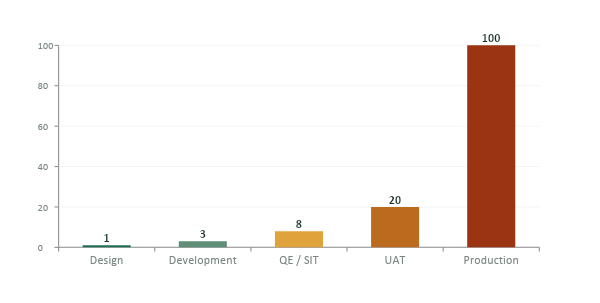
DEFECT-COST CURVE
-
Detection cost rises roughly an order of magnitude per phase.
-
Virtual services enable integration-level testing from day one — at the 1×–3× tier.
The marginal cost of a test approaches zero.
Integrated test environments are costly to provision, maintain, and keep available; metered dependencies bill per invocation. A virtual service is lightweight, on-demand, and free at the point of use. Substituting it for always-on integrated stacks and metered calls reduces standing expenditure on several axes at once.
COST LEVERS
- Per-invocation charges on metered APIs and lookups — eliminated.
- Duplicated integrated environments — consolidated.
- Always-on stacks — replaced by on-demand virtual services.
- Environment licensing and maintenance overhead — reduced.
Virtualize selectively, not exhaustively.
Virtualising indiscriminately produces a shadow estate no one trusts. Four properties identify a dependency that genuinely warrants a virtual service:
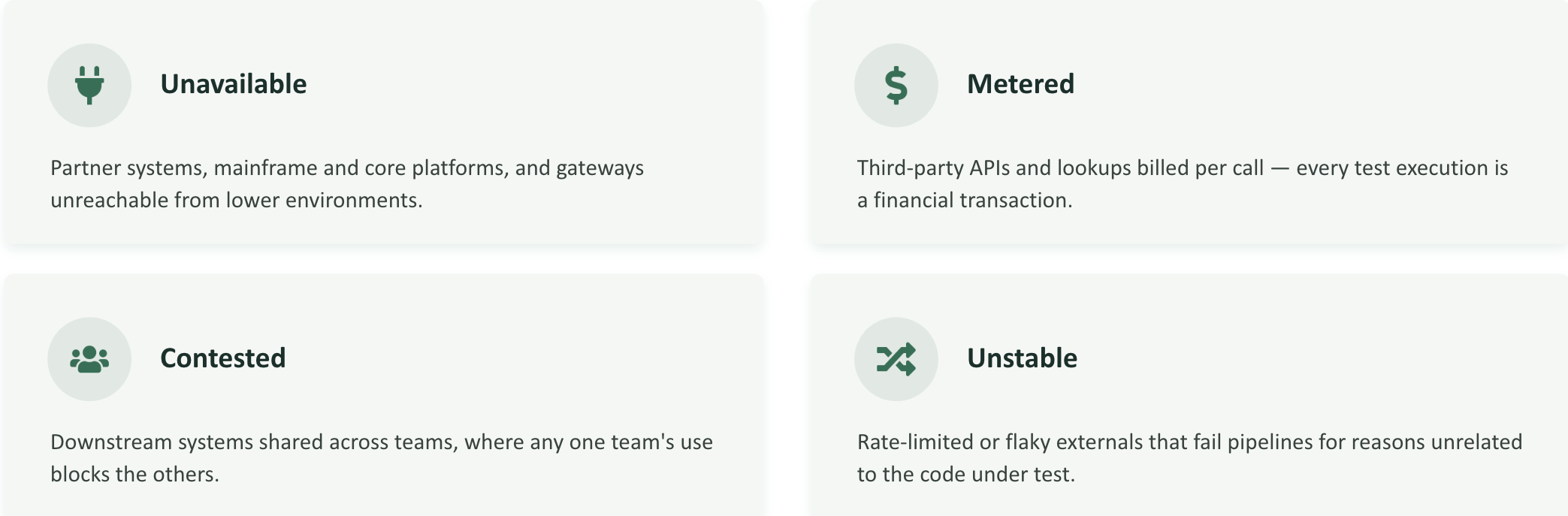
Specify the contract before the implementation.
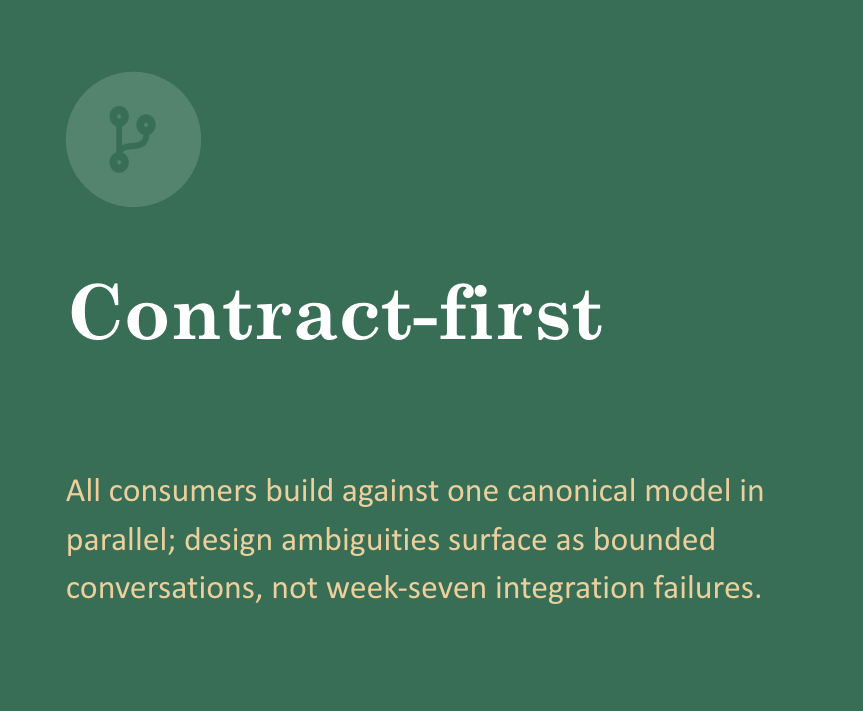
Reactive mocking - built only when a dependency is unavailable - captures roughly a third of the value. The full return follows from defining each service contract at the outset, constructing a virtual service to it, and treating that contract as the canonical artefact against which all consumers develop.
The contract is a versioned artefact - reviewed, owned, and updated deliberately, not an ad-hoc stub. Defining it early forces design ambiguities to surface as bounded conversations rather than late-stage integration failures.
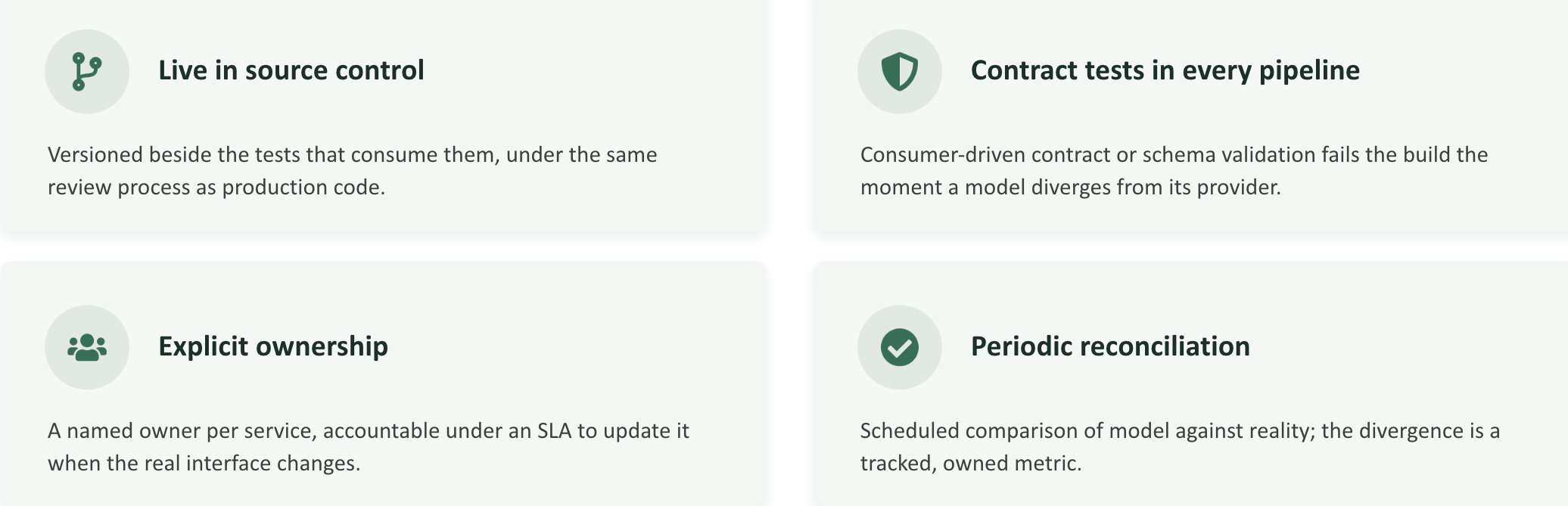
Treat virtual services as versioned engineering artefacts.
Unmanaged, virtual services drift from the systems they model and quietly invert their value — supplying false confidence. Four disciplines preserve fidelity over time:
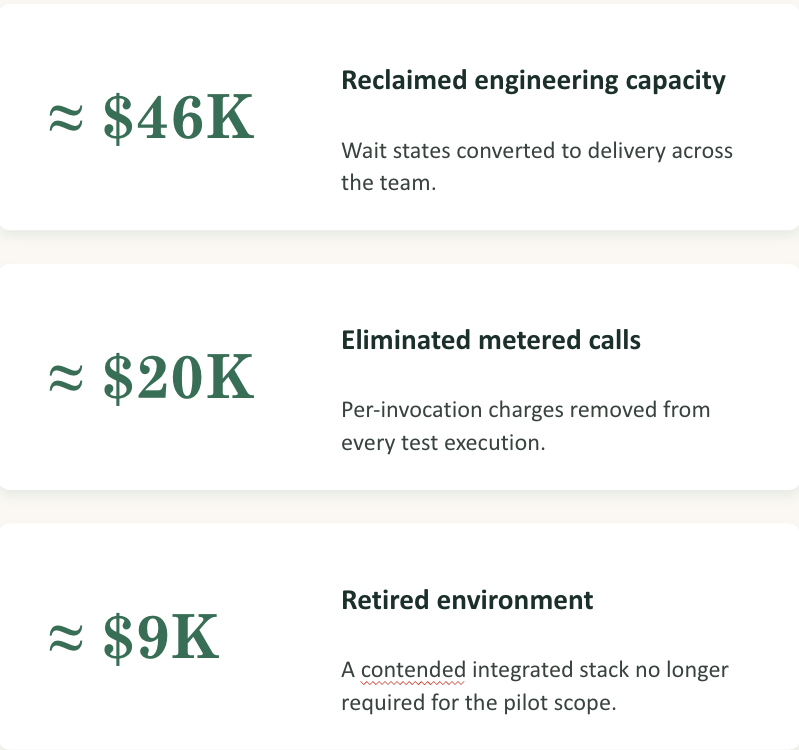
$75,000 recovered within three weeks of implementation.
A focused pilot — a single team, a single high-cost dependency — returned measurable value almost immediately. Once the virtual service entered the pipeline, recovered value decomposed across all three vectors:
The constraint is not immutable.
Begin with one team and the single dependency that blocks it most. Virtualise that dependency, integrate it into the pipeline, and measure velocity over four weeks. A documented pilot is more persuasive than any projection — and it is the empirical foundation on which a broader programme is justified and scaled.