



Executive Summary
A new class of AI model makes decisions instead of writing text. TypeSafe AI launched Jev, the first "System One model", on September 15, 2026; Convai Innovations released Laya, an open-source counterpart, days later.
Both take a record (a ticket, an email, a JSON object) plus typed questions, and return every answer in one pass with a calibrated confidence score. TypeSafe claims Jev is 40x–200x faster than frontier LLMs; Laya claims about 33 ms per decision on one T4 GPU.
Our view: System One models will not replace LLMs. They will take over the high-volume, bounded decisions inside enterprise workflows, such as routing, triage, approvals, and classification, where LLMs are slow, costly, and hard to audit.
What System One Models Are
Most AI calls inside software are decisions, not prose: which queue, how urgent, approve or hold. An LLM answers by generating text that code must then parse, which is slow, costly, and prone to malformed output and overconfident guesses (TypeSafe).
A System One model takes unstructured state in and returns typed, probabilistic decisions out. The name comes from Daniel Kahneman's fast, intuitive "System 1" thinking; Jev is named after economist William Stanley Jevons.
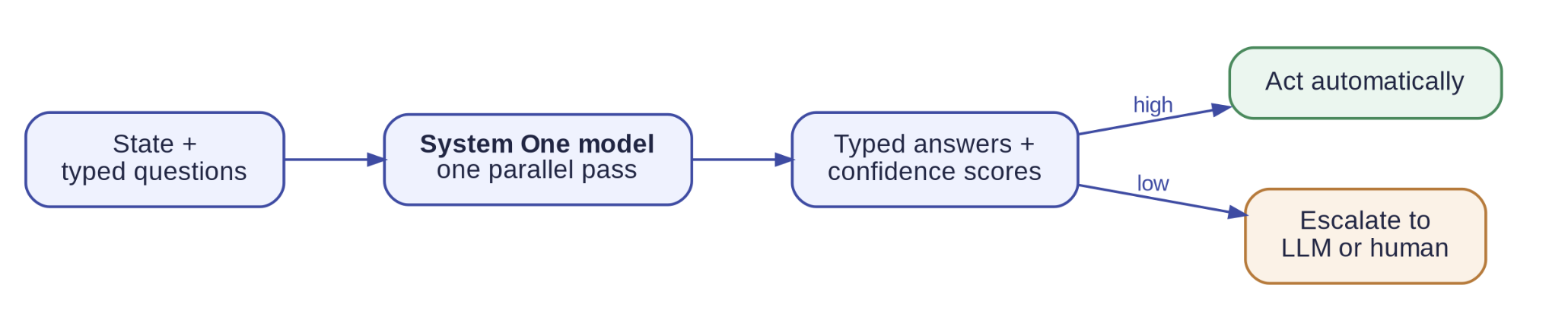
Three ideas set them apart:
- One parallel pass. All answers come out at once, not token by token, so adding questions barely adds latency.
- Type safety by construction. Answers can only be values from a schema you define, so there is no malformed output or invented value.
- Calibrated confidence. Both models are trained with Reinforcement Learning for Calibrated Decisions (RLCD), which rewards honest probabilities. Code can act when the model is sure and escalate when it is not.

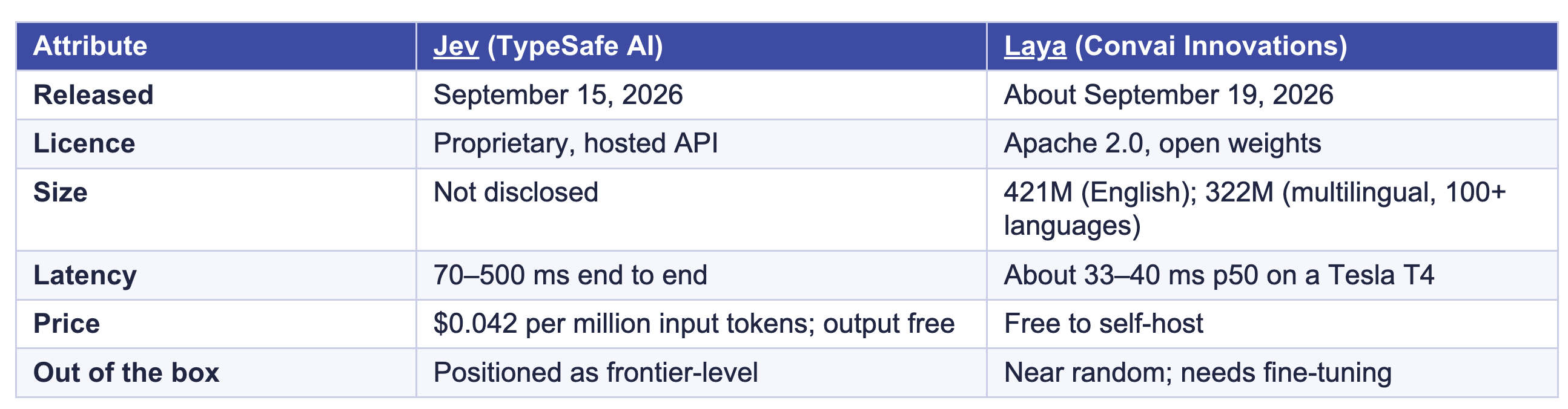
Jev And Laya At A Glance
Jev is the closed frontier model that defined the category. Laya is the open model you fine-tune and run yourself.
Reality Check
The category is days old, and most performance numbers still come from the vendors themselves.
- Speed is real; intelligence is unproven. Latency is easy to verify, but Jev's quality benchmarks use workflows written by TypeSafe's own team, which the company itself flags as a possible bias (TypeSafe).
- "Can't hallucinate" means no invalid output. The model can still choose the wrong valid option, which engineer Sean Goedecke calls a semantic dodge (Sean Goedecke).
- The moat is debated. Goedecke got a 2x–3x speedup by making an ordinary open LLM output one constrained token per question, though he expects a purpose-trained model to stay ahead.
- Laya needs work. Its headline 0.766 accuracy comes after fine-tuning on the benchmark's own data. Zero-shot, it is near random, and its confidence scores need recalibrating (AI Weekly).
The practical rule: test on your own records, with a held-out set, before building on either model.
Enterprise Use Cases
The best targets are business decisions that repeat thousands of times a day and have a fixed set of possible answers. When confidence is high, the system acts on its own. When it is low, the case goes to an LLM or a person.
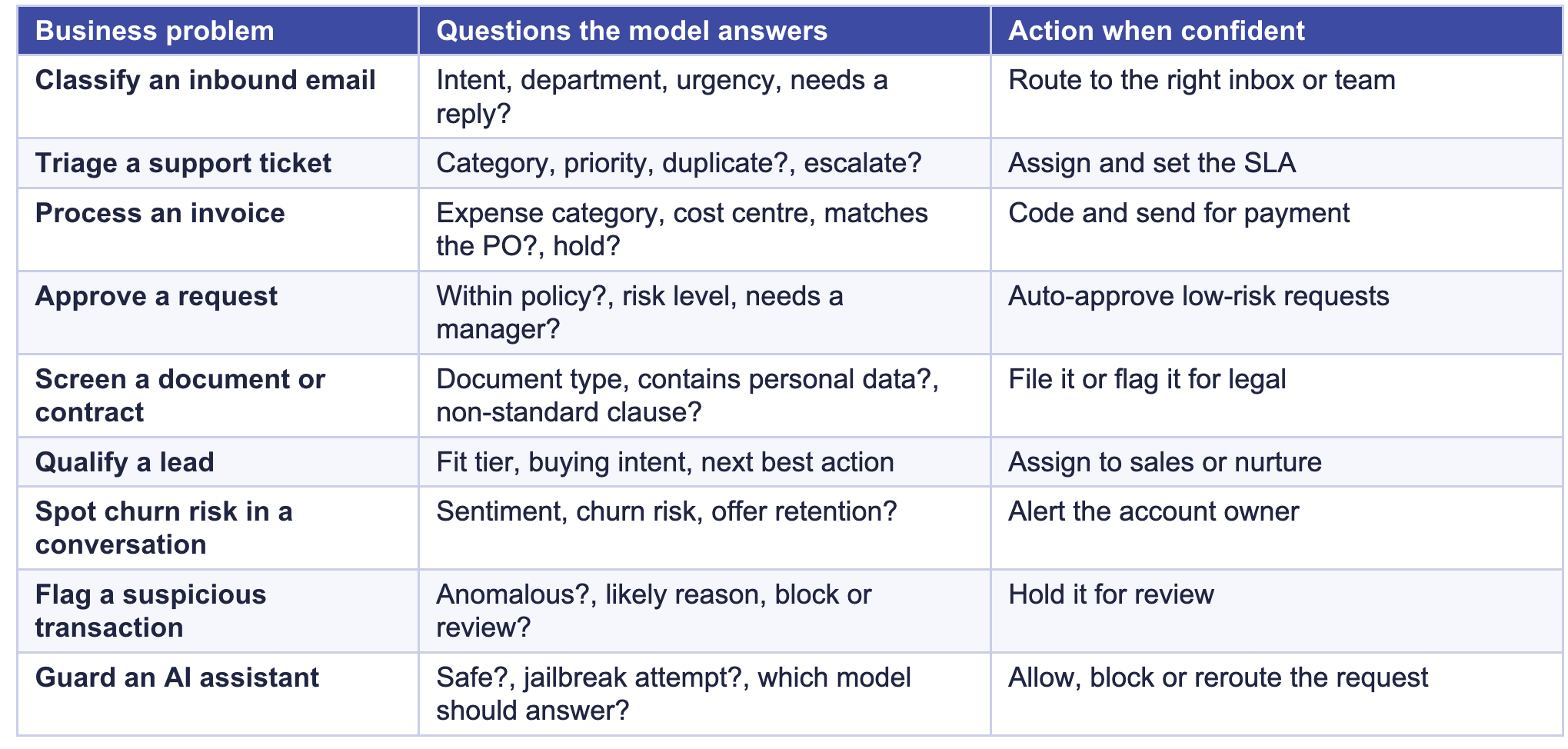
Choose Jev for strong results without training data. Choose Laya when data must stay on-premises, and you have labelled history to fine-tune on; for regulated clients in Canada and the EU, data residency may decide.
The Future: System 1 Plus System 2 Agents
The likely end state is not decision models replacing LLMs. It is agents that think fast and slow, as Kahneman described: a System One model handles the many quick calls, and a reasoning LLM takes the few hard ones.
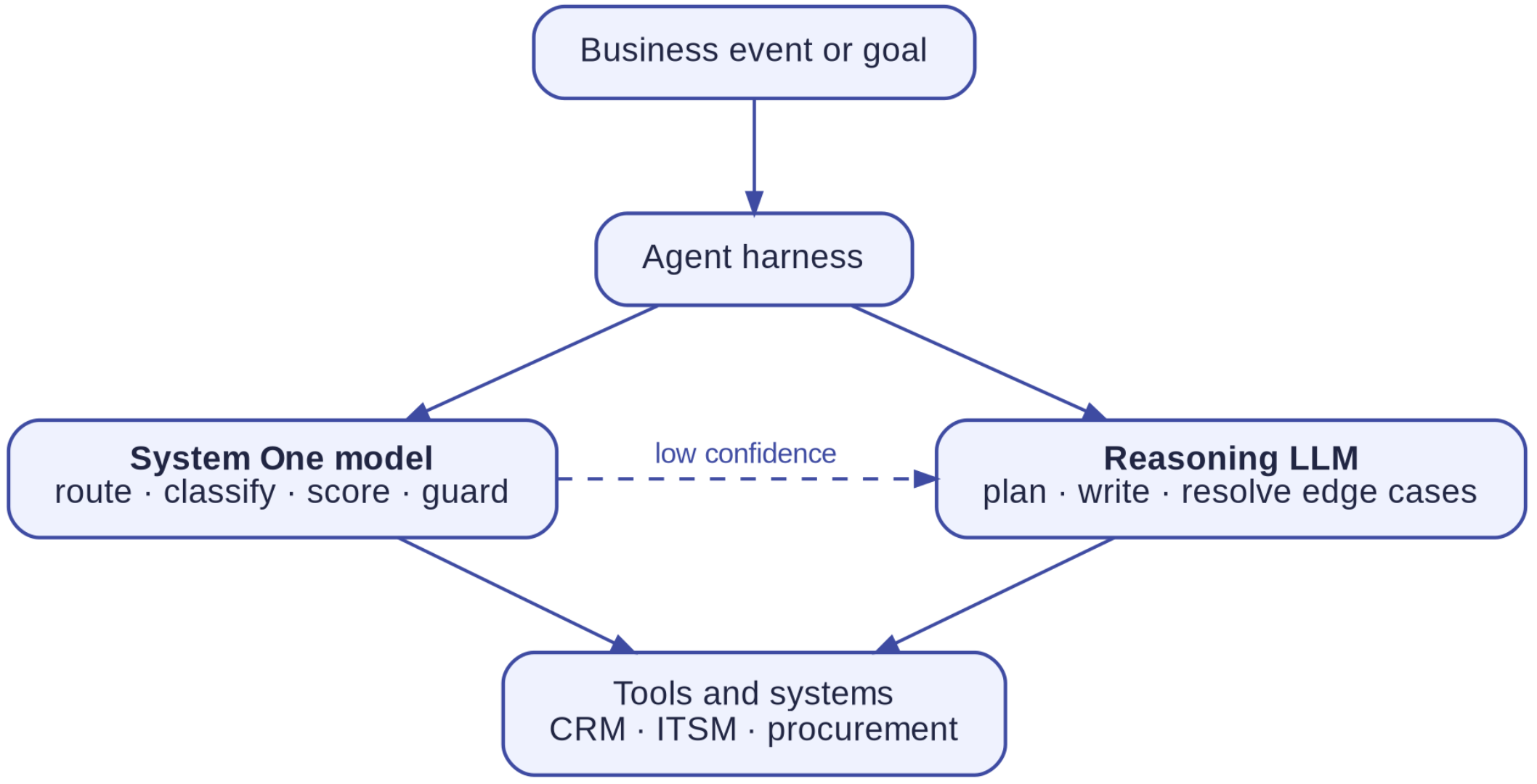
LangChain already frames it this way: use an LLM for open-ended reasoning and generation, and Jev for the fast, structured decisions along the way, including which model should handle each request (LangChain).
Three horizons
The dates below are Vericence estimates, not vendor roadmaps.
- Now to mid-2027: the decision layer. Early adopters replace brittle rules and slow LLM classification calls with decision models inside existing workflows: triage, routing, coding, guardrails.
- 2027 to 2028: the Jevons effect. As a decision costs a fraction of a cent and a tenth of a second, organisations add AI to steps they never automated. The number of AI decisions per workflow rises sharply, even as spend per decision falls.
- 2028 onward: machine-native intelligence. Most AI calls in the enterprise are made by software, not people. Agents run continuous loops over live state, and chat becomes the exception, not the default interface.
Signals to watch
- Whether major labs release their own System One variants, as Goedecke predicts they could easily do.
- Independent calibration benchmarks that test confidence scores on real enterprise data.
- Support for images and other non-text state; TypeSafe says its Doom demo uses text-described state, with images still to come.
- Native connectors from platform vendors such as Salesforce, ServiceNow and Coupa, or from integration middleware.
- Sustained pricing once early-access subsidies, if any, end.
How Vericence helps
Decision models are only as good as the decisions you define, the data you test on and the thresholds you set. That is where Vericence works, between platform vendors, AI-native tools, and system integration.
- Decision inventory. Find the high-volume, bounded decisions across your workflows.
- Bake-off on your data. Compare Jev, Laya, and your current LLM on accuracy, calibration, latency, and cost.
- Thresholds and governance. Set confidence thresholds, escalation paths, and audit logging for each decision.
- System 1 plus System 2 architecture. Design agent harnesses that route each call to the right model, without vendor lock-in.
Start with one question: which decisions do we make thousands of times a week from a fixed list of answers?
References
- Diogo Almeida, Introducing System One Models & Jev, TypeSafe AI, September 15, 2026.
- Convai Innovations, Laya model card, Hugging Face, September 2026.
- Convai ships Laya, a 421M ModernBERT decision model, AI Weekly, September 19, 2026.
- Sean Goedecke, Jev means structured output is interesting again, September 16, 2026.
- What Is Jev? A Guide to TypeSafe AI's System One Model, LangChain, September 2026.
.png?width=1200&height=628&name=Untitled%20design(33).png)