This is Part 3 of our series on the AI agent harness. In Part 1, we argued that every agent needs a harness, and in Part 2, that many agents need a shared one. This part asks what that harness should actually decide.
Two worlds, one enterprise architecture
Enterprise applications have traditionally relied on deterministic systems. Business rules, workflows, APIs and integrations are designed to produce predictable and repeatable outcomes.
Generative AI introduces a different paradigm. It can interpret ambiguity, understand context, analyze unstructured information and recommend actions. But its outputs are probabilistic, not guaranteed – the same input can produce different answers.
As enterprises adopt AI-driven and agentic applications, these two execution models must coexist. The challenge is not simply integrating AI into existing systems but architecting how intelligence and control work together.
Intelligence doesn't always mean control
Consider a healthcare prior authorization workflow.
AI can interpret clinical documentation, extract relevant information, analyze supporting evidence and assist in preparing authorization requests.
However, eligibility validation, business rule enforcement, transaction updates and interactions with enterprise systems require predictable execution.
Allowing AI to independently control the entire workflow introduces risks around accuracy, compliance and accountability. Restricting it to text generation, on the other hand, limits its potential.
The architectural question is – Where should AI make decisions, and where must deterministic systems retain authority?
Separating reasoning from execution
The two paradigms serve different purposes.
- Probabilistic AI – Interpretation, contextual reasoning, knowledge retrieval and recommendations.
- Deterministic systems – Business rules, validations, authorization, transaction integrity and state management.
The complexity emerges at their boundaries.
AI-generated recommendations need validation before becoming business actions. Tool invocations require authorization. Failures need predictable recovery paths. Decisions and execution traces must remain observable and auditable.
This is no longer just an AI integration concern. It is an enterprise architecture responsibility.
A controlled collaboration model is the answer
A practical architecture separates reasoning from execution while allowing both to collaborate.
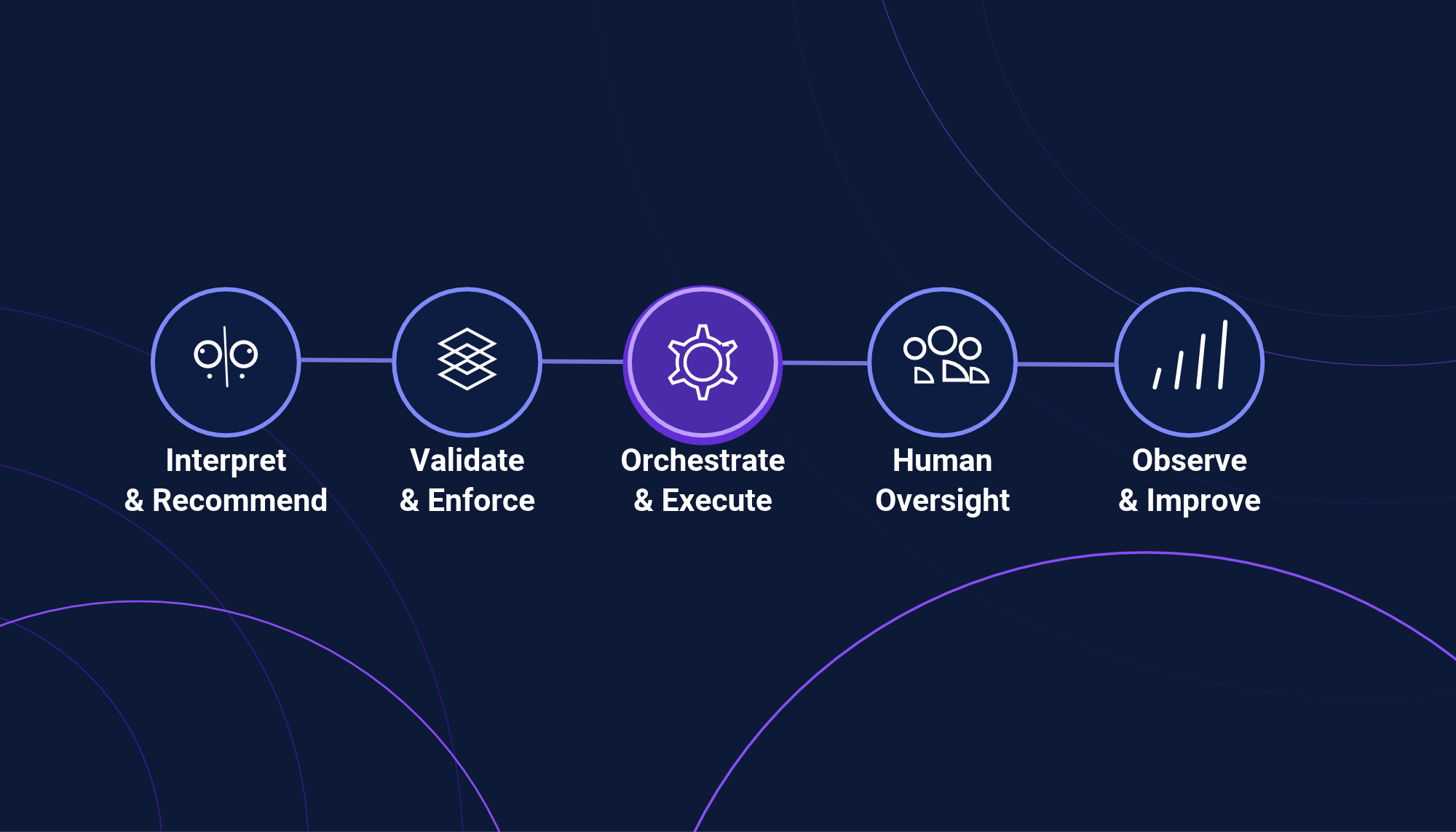
AI interprets and recommends. A validation and policy layer, the harness, enforces business constraints. Orchestration coordinates the workflow, while deterministic enterprise services execute approved actions.
Human intervention remains part of the architecture for high-impact decisions and exceptions.
Back to prior authorization – AI reads the clinical notes, drafts the request and flags missing evidence. Deterministic services check eligibility, apply payer rules and submit the transaction. A clinician reviews any request the AI is not confident about. The AI does the reading; the systems of record keep the authority.
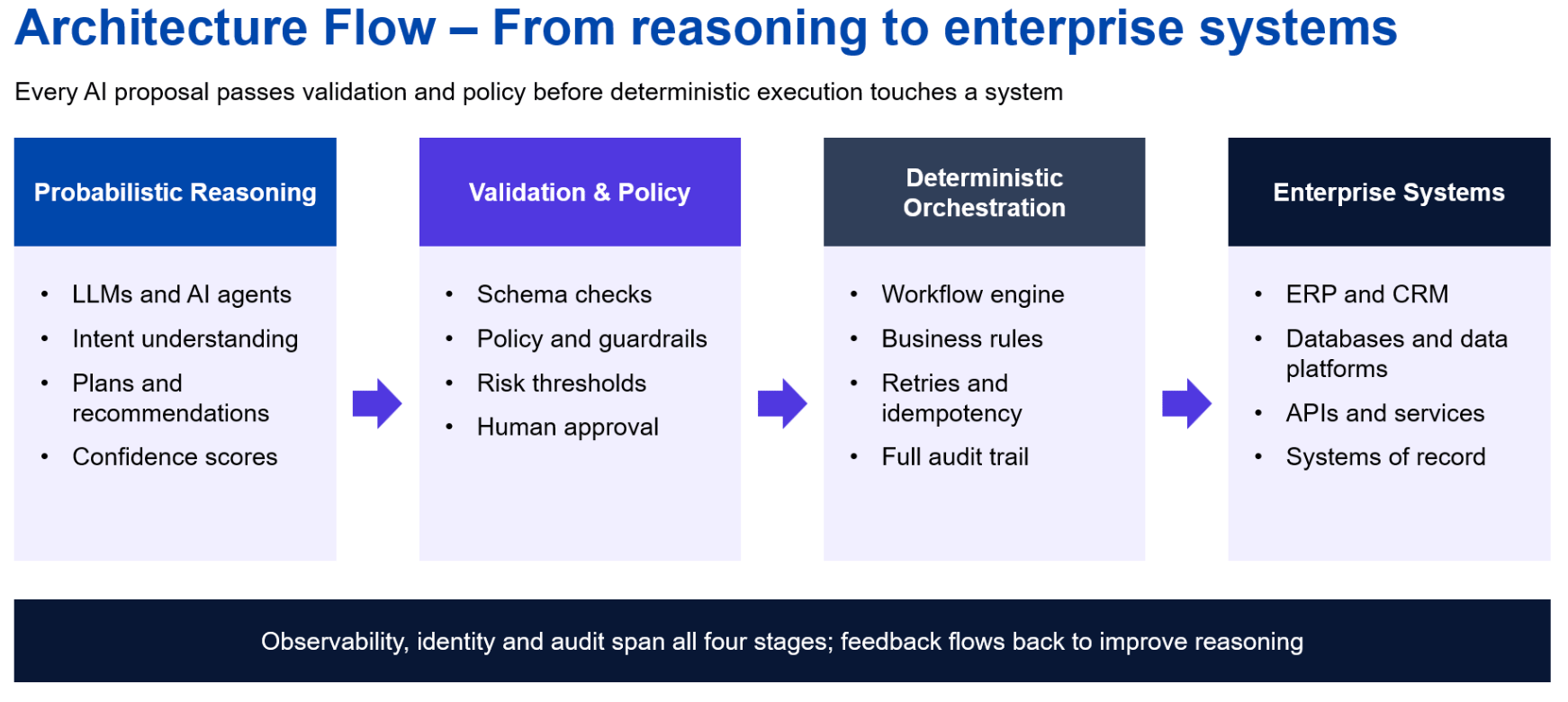
Observability should span the entire flow, capturing AI outputs, validation decisions, tool interactions and business outcomes.
Vericence perspective: Architect for controlled intelligence
At Vericence, we believe enterprise AI adoption should focus on augmenting established systems rather than replacing their fundamental responsibilities.
AI capabilities should be modular, governed and replaceable. Business rules should remain explicit. Critical transactions should follow controlled execution paths.
The objective is not maximum AI autonomy. It is the right level of intelligence with the right level of control.
As enterprises move toward agentic applications, the next architectural challenge is not just making systems intelligent but deciding how much authority that intelligence should have.
How much of an enterprise workflow should we allow AI to control, and where should deterministic systems retain the final authority?